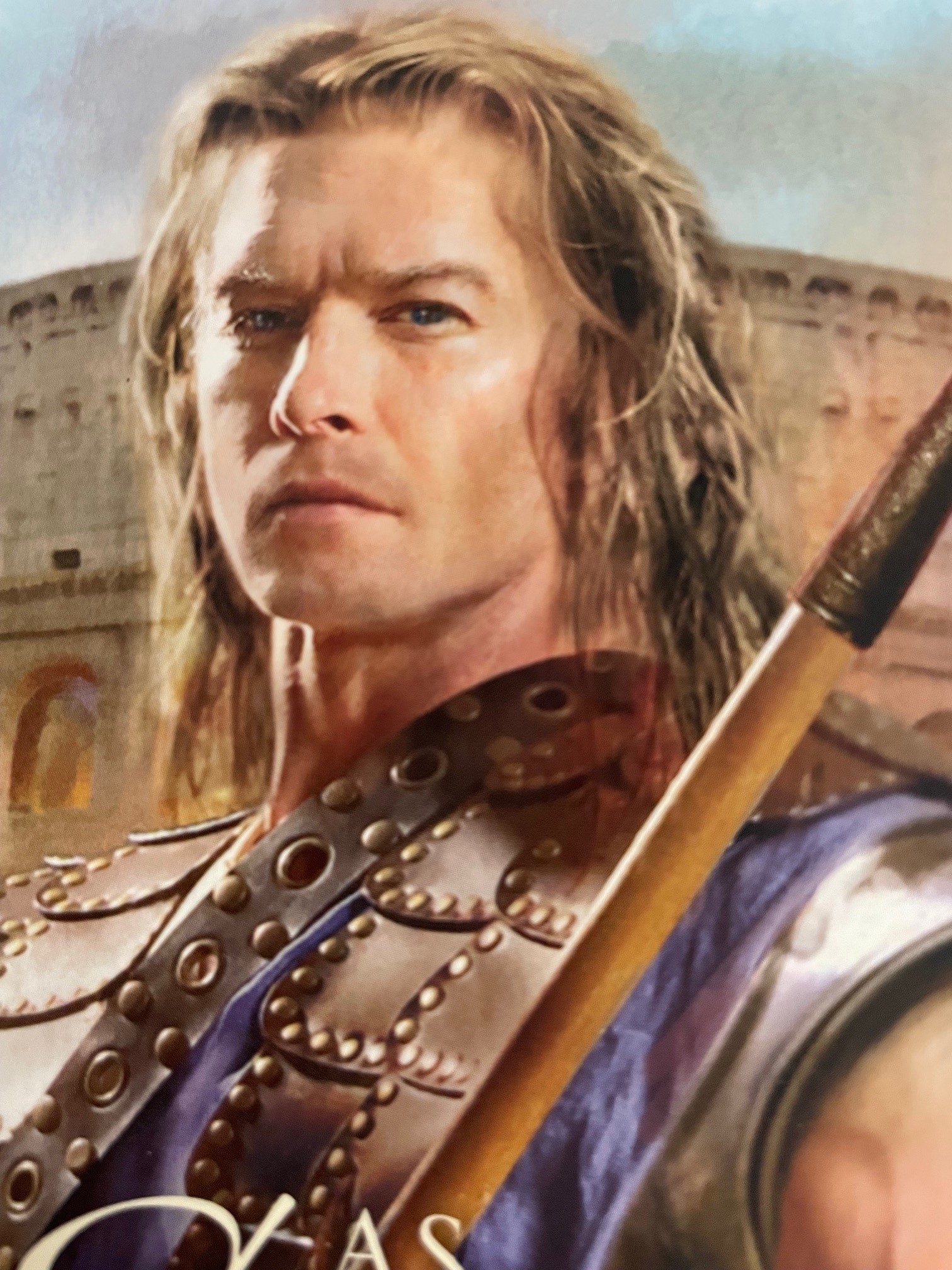
I have been interested in gladiators since seeing the movie “Spartacus” with my parents in October 1960 at the Golden Gate Cinerama – with the huge wrap-around screen. Years later, I created a gladiatorial character – Atretes, a captive Germanic “barbarian” – in The Mark of the Lion trilogy. It was possible for a gladiator to fight his way to freedom (25 fights to receive the rudis – a wooden sword). But at what cost to the human psyche?
There is a fascination with gladiators, Gladiator and Gladiator II are prime examples. “Those who are about to die salute you.” Not that these men had a choice, though some volunteered; the Emperor Commodos as an example. Most were captives of Rome, taken during or after a war to bring “Pax Romana”. The first games go back to 264 B.C. — contests at a funeral to commemorate a high official or person of wealth. Historical evidence showed these contests gained popular support. 216 B.C. – 22 gladiatorial pairs fought, 200 B.C. – 35 pairs, 183 B.C. 60 pairs, 14 B.C. 74 pairs in three days. Individuals staged and paid for the games and had an editor (sponsor). Pompeii and Caesar held games to gain popularity and power.
As time went on, the games became more extravagant. Awnings protected the crowds from the heat. Historical documentation tells of four months of games in Rome, 11,000 animals (exotics) killed in contests, and 10,000 pairs of gladiators fought to the death.
Imagine one day of games at the Colosseum. 45-55,000 thousand people poured through 76 entrances and sat in tiers by rank. The “fun” started with beasts on display and set to fight men (bestiaries) amid false lakes and hills. Noon brought an exodus of hungry people looking for snacks from food stands outside the arena. Noon was also the time when public executions took place in the arena. This included crucifixions, burning people alive, mass pitched battles of the condemned, mythological re-enactments such as Orpheus dropped into a cage of bears – and, of course, “refreshing” the sand. Next came the gladiators, captives from all over the Empire who suffered harsh, brutalizing training in ludi and became secutors (shield and gladius), retiarius (short sword and trident), dimachaerus (two swords), essecharius (rode in a war chariot) among others. Spectators admired endurance, bravery, and courage. Any sign of weakness brought death.
Why were the games so popular? Some from that time believed that human beings are drawn to violence and depravity and the games “harnessed” it. When one looks at history, we see it did just the opposite. What you feed grows, and so it is with the sin nature.
When writing A Voice in the Wind, I could see so many parallels to our culture and the world today. Human beings have not changed. We are not evolving. We still feed that selfish, rebellious, I-want-to-be-God nature we share with Adam and Eve. The only way we can change is by becoming a new creation in Christ Jesus and receiving the indwelling of the life-giving Holy Spirit. When that happens, we put on the Spiritual armor of God and enter a war more intense than any you will ever see on screen.